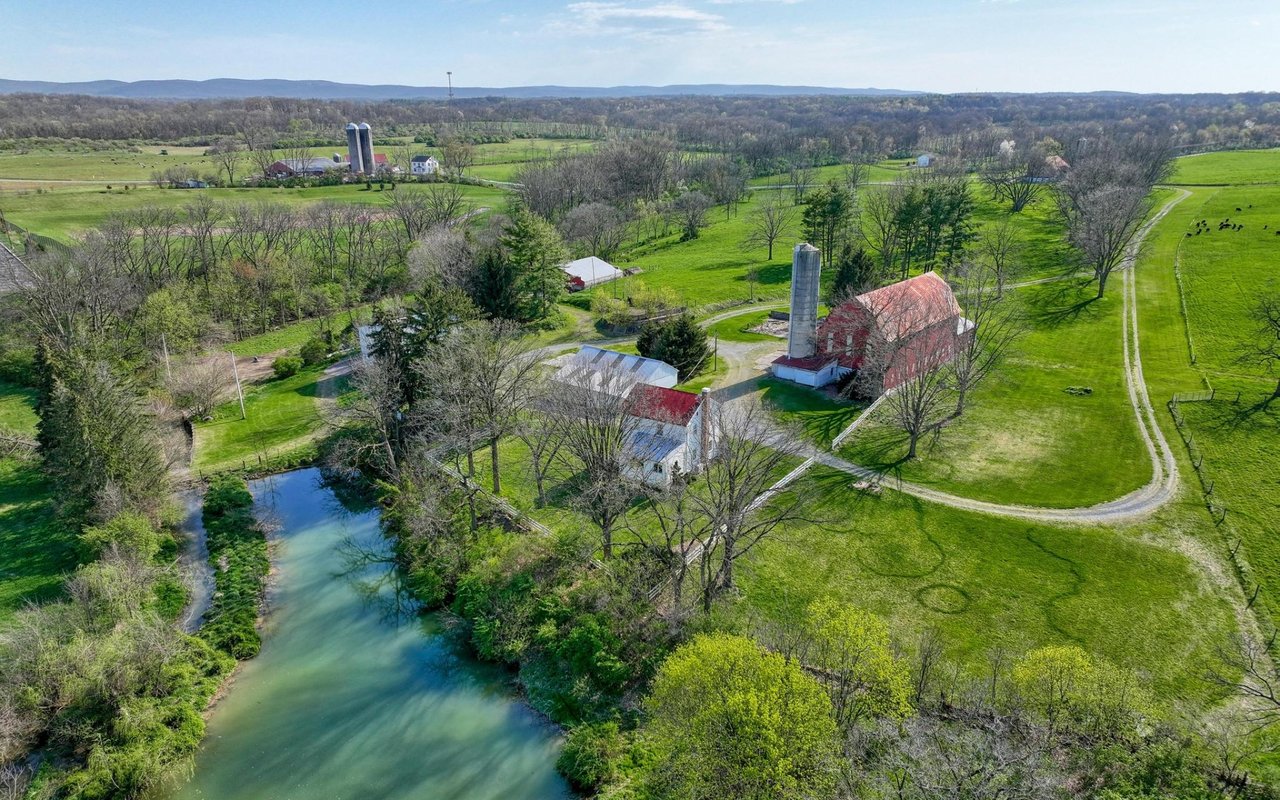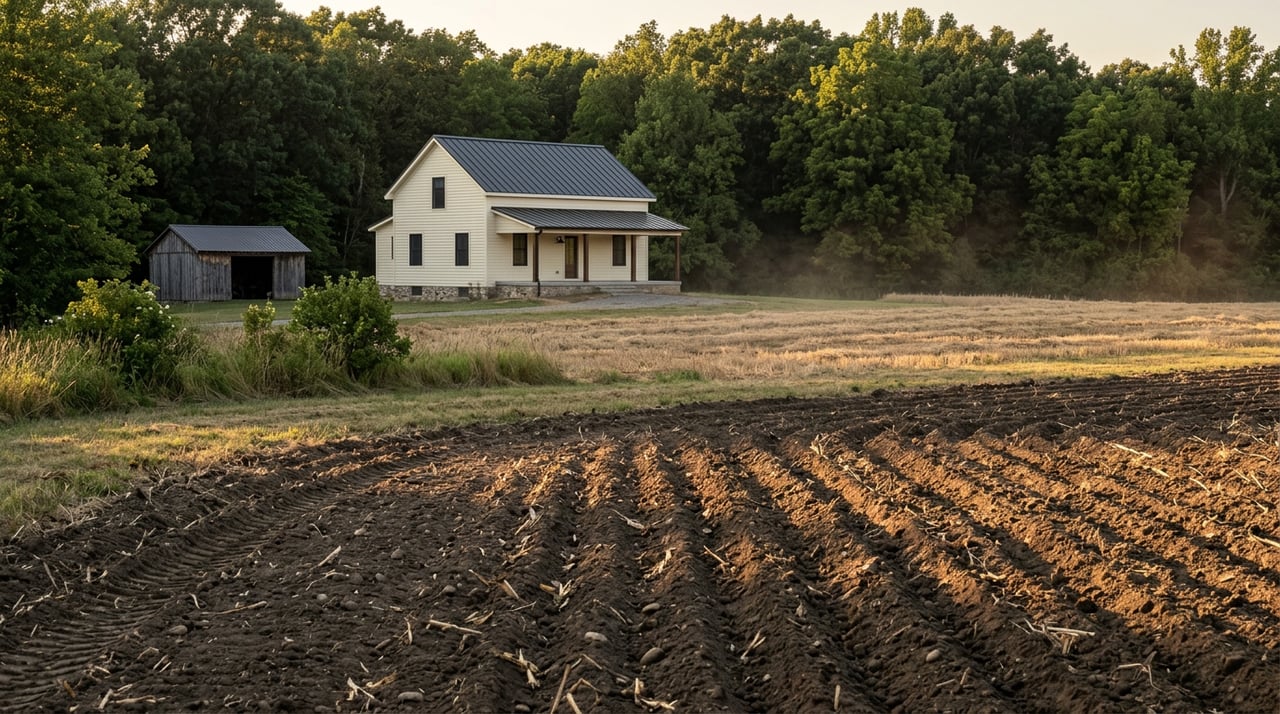
A farm in Warrington Township and a farm in York Township can carry the same tillable acres, the same soil map, and the same barn. Put them side by side on the open market and one may clear twice what the other does. The reason has less to do with the dirt than with what a warehouse developer would pay to pave it, and that single spread is the number every York County farm seller should be running before they touch a preservation application.
The York County Agricultural Land Preservation Board pays for development rights. It does not pay for farms. Understanding the difference is the whole game.
The mechanism, not the marketing
The York County program operates on a cap. County offers on agricultural conservation easements are limited to $3,500 per acre under the current program page, though older county FAQ material still references a $3,000 cap. That figure is not a valuation of the land. It is the ceiling on what the county will pay for the right to say no to future development on that parcel.
The math the county's appraisers actually run is a subtraction. State certified general real estate appraisers determine market value and farmland value on the same tract, and the difference between the two is the conservation easement value. Preservation pays that spread, capped.
That framing changes everything downstream. If a farm sits in a submarket where the highest bidder is another farmer, market value and farmland value are close to identical and the easement spread is thin. If it sits where a developer would outbid every farmer in the county, the spread is wide, and the $3,500 cap becomes a discount on what the open market would pay for the development potential.
The cap is not the price of your farm. It is the price of a promise never to develop it. What that promise is worth depends entirely on which township you drive out of every morning.
Where the spread actually lives
York County is not a single land market. Preservation activity has concentrated in five townships where the Farm & Natural Lands Trust of York County now holds more than 5,600 conservation easement acres: North Codorus, Springfield, Codorus, Warrington, and Hellam. Those are not accidents of geography. They are places where farming remains competitive with the next-best use of the ground.
Warrington Township is the clearest illustration. It sits bordered by eight townships and stays rural in part because Gifford Pinchot State Park and Roundtop Mountain Resort absorb the middle of the map. When Warrington's farmers could not score enough points to qualify for state preservation dollars, township officials created a farmland preservation overlay covering most of the township. Supervisor chair Jason Weaver has been direct about the purpose, telling the York Dispatch in December 2025 that it keeps large developers out and keeps the township more rural.
Compare that to the corridor around York Township, where the Hudson Ridge project off Chapel Church Road has been actively expanding through 2025. Same county. Different economics. The seller in Warrington is choosing between two farmer-buyers and a preservation check. The seller near an active development is choosing between a preservation check and a builder's offer that no farmer will match.
A rough framework for a York County landowner
Instead of a spec sheet, run the question through three filters before deciding whether to apply, sell, or sequence both:
- Who is the marginal buyer in your township this year? If the last three transactions inside two miles were farm-to-farm, your development premium is small, and $3,500 an acre for the easement is close to found money on top of an eventual farmland-value sale. If the last three transactions were rezonings or subdivisions, the spread is wide and the cap is a real cost.
- How urgent is the timing? The program moved off its continuous application cycle. Applications are now qualified and ranked every 24 months, and the next deadline is February 15, 2026. A landowner who wants to sell in 2026 and preserve first is running against that calendar; a landowner selling in 2028 has a full cycle to plan around.
- What does the family actually want to keep? After selling an easement, the owner retains title, the right to sell, lease, mortgage, and pass to heirs, and under Act 33 of 2019, the right to subdivide off an existing house or one to be built. What is gone, in perpetuity, is the right to convert the ground to anything other than commercial agricultural production. Rare buyback provisions exist after 25 years and only if the land is no longer feasible to farm, which the state assumes will almost never be true.
The scale of what has already happened
The board's own totals, reported at the February 17, 2026 meeting, put the program at 360 easements on 50,590.11 acres. York County celebrated 50,000 acres preserved in August 2025, one of six county milestones the Bureau of Farmland Preservation logged in its 2025 annual report, published May 1, 2026.
The county has budgeted around $206,000 in departmental operating funds for 2026, with roughly 15 farms preserved each year, and officials have earmarked $1.58 million for the preservation program plus another $470,000 for the Farm and Natural Lands Trust of York County. The funding stream is a dedicated tenth-of-a-mill real estate tax first levied countywide in 2020.
For a seller trying to read the tea leaves, the important signal is scarcity. Fifteen farms per year against a two-year application backlog means an applicant filing in February 2026 is competing against every other farm ranked in the same cycle, on a scoring system that weighs soil quality, likelihood of conversion within 20 years, and proximity to already-preserved tracts. A farm surrounded by preserved neighbors scores well. A farm out on an island scores worse, even if the ground is better.
That creates a second-order effect the market rarely names: preservation clusters compound. Once a township passes a certain density of easements, remaining unpreserved parcels inside the cluster are less attractive to developers, which shrinks the development premium, which shrinks the easement value the county would pay. Wait too long inside a preservation-heavy township and the spread you were counting on collapses.
Comparing what the ground trades for beyond the county line
York County does not publish a per-acre farmland index the way land brokerages do for neighboring markets, but the regional comps sit close enough to be instructive. In nearby Franklin County, farmland listings have carried an average price around $29,716 per acre and a median near $27,591 per acre in mid-2026 tracking. Broader all-property land listings there average roughly $38,736 per acre.
Those figures are not York County numbers, and land in the northern York suburbs will not price like land in Mercersburg. The point is directional. When farmland regionally trades in the high five figures per acre, a $3,500 per acre easement payment covers development rights only. It does not compete with a market sale, and it was never designed to. The remaining farmland value stays with the landowner, available to sell later or pass down.
That is the argument for stacking. Sell the easement, keep the farm, then either continue operating or sell the encumbered ground at farmland value to another farmer, a beginning farmer certified for realty transfer tax exemption under the state's qualified beginner farmer program, or a family member. Landowners like the Phillips family in Codorus Township, whose fourth preserved farm brought them past 1,000 total preserved acres in December 2025, and Hanover Shoe Farms across the line in Conewago Township, Adams County, at over 3,100 preserved acres, are running this playbook at scale.
Transaction friction most owners underestimate
A preservation sale is not a real estate closing. It is a program with its own checklist, and the checklist bites at predictable places.
- Lender consent. Enrollment requires permission from every owner of record and from your lender. A mortgage that predates the easement can stall the whole file until the lender agrees to subordinate.
- Conservation plan. A soil and water conservation plan or an Ag E and S plan must be in place with at least 50% implemented at application. This is not something to start in January for a February 15 deadline.
- Agricultural Security Area enrollment. Only farmland duly enrolled within an ASA meeting minimum program criteria is eligible. Enrollment happens at the municipal level and is not automatic.
- Appraisal disputes. A farmer who disagrees with the county's appraisal may retain an independent appraiser at their own expense, and the two values are then reconciled through a state formula worksheet. The county board may or may not raise the offer.
- Perpetuity. Every restriction runs with the deed forever. Future heirs cannot undo it because grandpa changed his mind.
None of these are dealbreakers. They are timing constraints, and a seller who learns about them in March of the year they wanted to close has already lost a cycle.
FAQ
Does selling a conservation easement in York County affect the ability to build a house on the farm?
No, with conditions. Under Act 33 of 2019, an owner may subdivide off an existing house located on a preserved farm or a house to be built, and may construct one additional residential structure for the owner, an immediate family member, or a farm employee. Township ordinances still govern building and construction.
Are mineral, oil, and gas rights lost with the easement?
Coal, oil, and gas exploration and utility right-of-way transportation of those resources are not affected by the easement sale. Granting a private right-of-way is prohibited.
Is the $3,500 per acre cap the same as the offer price?
No. The offer is the lower of the appraised easement value, which is market value minus farmland value, and the county's per-acre cap. In townships with low development pressure, the appraised value can come in well below the cap.
Working the numbers before the deadline
The right move on a York County farm is rarely obvious from a listing sheet. It comes from stacking the township's development trajectory, the family's timeline, and the arithmetic of the easement spread against each other, and then deciding whether to preserve first, sell first, or run both tracks at once. That is a conversation, not a form.
If you own farm ground in York County and want a candid read on where your parcel sits inside that math before the February 15 cycle closes, Dustin Prievo and the team work these files across south central Pennsylvania every season. Reach out and we will walk the ground with you.